
AI Trends in 2026: What’s Shaping the Future of AI
 Vijay Singh Khatri
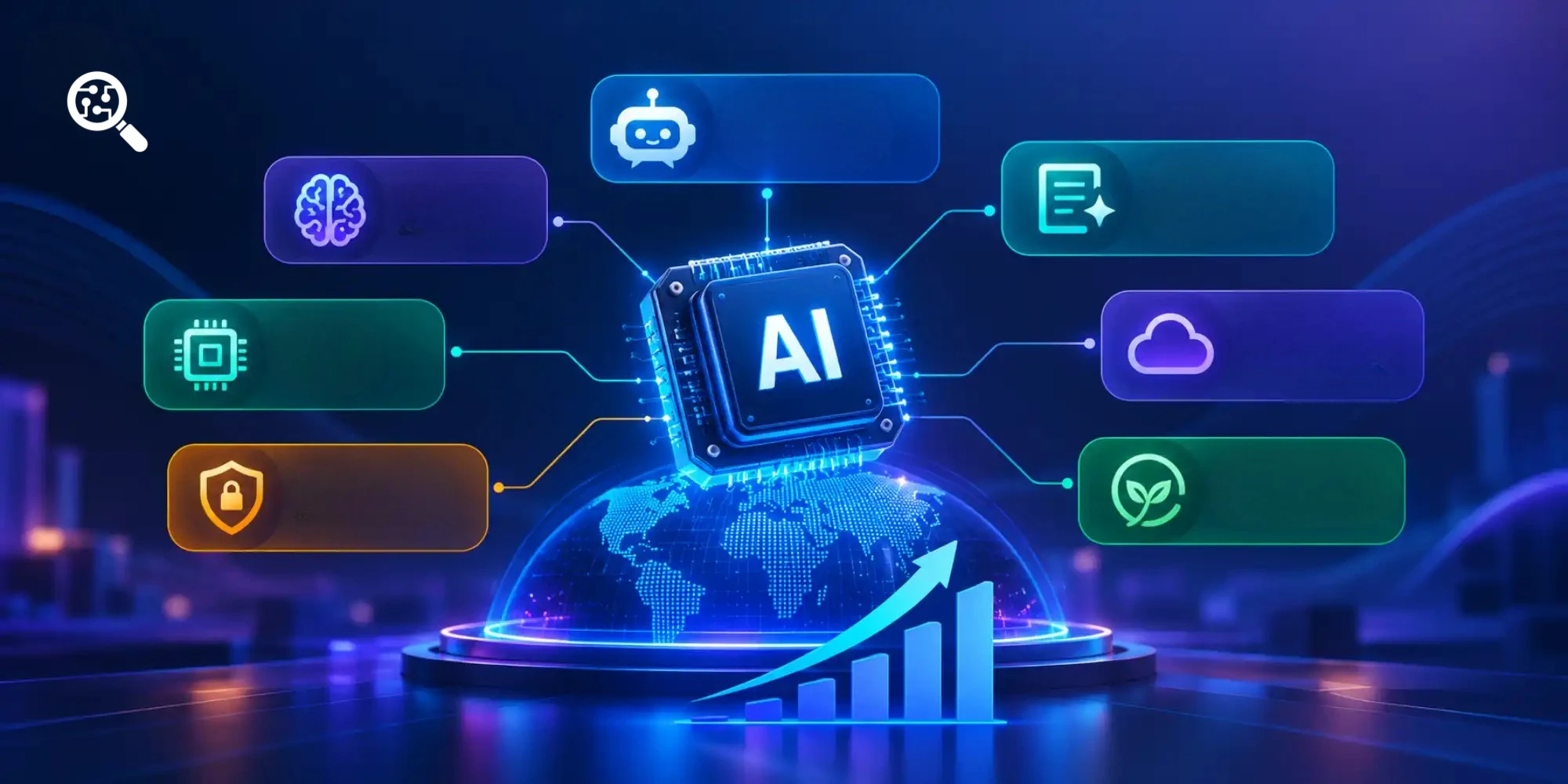
Artificial intelligence in 2026 looks very different from the AI boom that began a few years ago. The conversation is no longer centered only on chatbots that can write emails, summarize documents, or generate images. AI is moving deeper into everyday software, business workflows, coding environments, research, customer service, and personal productivity.
The numbers reflect that shift. According to the Stanford AI Index Report 2026, 88% of surveyed organizations used AI in 2025, while 70% were already using generative AI in at least one business function. Generative AI also reached an estimated 53% adoption within three years, faster than the adoption curves of both the personal computer and the internet.
But adoption is only part of the story. In 2026, AI is becoming more autonomous, multimodal, specialized, personalized, and deeply connected to other software. At the same time, businesses are asking harder questions about cost, reliability, security, governance, and whether their AI investments are actually producing measurable results.
So, what are the biggest AI trends shaping 2026? Here are ten developments worth watching.
AI Trends 2026
1. AI Agents Are Moving From Answers to Actions
One of the biggest AI trends in 2026 is the rise of AI agents.
Traditional generative AI follows a relatively simple pattern: you provide an instruction and the model generates a response. An AI agent can go further by breaking a goal into steps, using tools, retrieving information, taking actions, checking results, and deciding what to do next.
Consider the difference between asking AI to write a sales email and asking an agent to help manage a sales workflow. The first system produces text. The second could potentially research an account, review previous communication, update CRM information, prepare a personalized email, schedule a follow-up, and ask for approval before anything is sent.
That shift is already attracting serious enterprise interest, although actual deployment depends heavily on how researchers define an "agent." Stanford's 2026 AI Index found that AI agent deployment remained in the single digits across nearly all business functions in its 2025 organizational data.More recent enterprise surveys suggest experimentation has accelerated substantially, while Forrester cautions that truly scaled production systems remain far less common than the industry's enthusiasm might suggest.
This distinction matters. AI agents are real, but 2026 is better described as the beginning of serious agent adoption than the year every business hands its operations to autonomous software.
The most practical model is emerging somewhere between manual assistance and complete autonomy. AI handles routine steps independently, while people retain control over consequential decisions.
2. Multimodal AI Is Becoming the Default
For several years, AI tools were largely separated by format. One tool generated text, another generated images, another transcribed audio, and another worked with video.
That separation is disappearing.
Multimodal AI systems can increasingly understand and generate combinations of text, images, audio, video, documents, code, charts, and other structured information within the same interaction.
This better reflects how people actually work. A marketer may need to understand a spreadsheet, customer comments, product images, video performance, and campaign copy at the same time. A developer may work with source code, logs, documentation, screenshots, and diagrams. A researcher may need to analyze papers, tables, figures, equations, and datasets together.
Stanford's 2026 AI Index reports continuing gains across multimodal reasoning alongside improvements in scientific reasoning, mathematics, coding, speech, and video.
The practical effect is that users will increasingly expect one AI system to understand whatever information they give it rather than thinking about whether they need a "text AI" or an "image AI."
The interface is changing too. AI interaction is expanding beyond typing into a chat box toward voice, cameras, screen understanding, file analysis, and real-time visual assistance.
3. Smaller AI Models Are Becoming More Important
Bigger is no longer automatically better.
For years, progress in AI was closely associated with building increasingly large models. Frontier models still matter, particularly for difficult reasoning tasks, but smaller and more efficient models are becoming increasingly capable.
Stanford's 2026 AI Index highlights how data quality, pruning, deduplication, and better post-training techniques can allow substantially smaller systems to achieve competitive results on some benchmarks. One example cited in the report, OLMo 3.1 Think 32B, uses nearly 90 times fewer parameters than Grok 4 while producing comparable results on several evaluated benchmarks.
That does not mean small models are replacing frontier models. It means AI products have more choices.
A straightforward classification task may not need the most powerful model available. A customer-support workflow might use a smaller model for common requests and send difficult cases to a stronger model. Sensitive information could be processed locally while less sensitive tasks use cloud-based AI.
This approach can improve speed, privacy, and cost efficiency.
Over time, users may not even know which model is answering a particular request. AI software will increasingly route each task to whichever model provides the best combination of capability, latency, privacy, and price.
4. Specialized AI Tools Are Challenging General-Purpose AI
General AI assistants are becoming more capable, but specialized AI products continue to have an important advantage: they can be designed around a specific workflow.
A legal professional does not simply need a chatbot that understands language. They may need contract comparison, case research, citations, document management, permissions, and integrations with legal workflows.
A developer may need repository indexing, terminal access, debugging, testing, and code review. A researcher may need academic search, source verification, citation management, and PDF analysis.
That creates room for specialized AI in healthcare, finance, law, marketing, cybersecurity, coding, research, education, e-commerce, real estate, design, and other industries.
This specialization may become even more important as leading foundation models become closer in general capability. Stanford reports that as of March 2026, models from Anthropic, xAI, Google, and OpenAI were clustered within 25 Elo points of one another on a human-preference Arena leaderboard.
When underlying model performance becomes more competitive, the differentiator moves elsewhere: workflow design, proprietary data, reliability, integrations, price, domain expertise, and user experience.
That is good news for AI tool users. The "best AI" increasingly depends on what you are trying to accomplish rather than which company has the highest general benchmark score.
5. AI Is Becoming a Feature Inside Everyday Software
One of the most important AI trends is also becoming increasingly difficult to notice.
AI is moving from being somewhere you go to something that is already inside the software you use.
Productivity platforms can generate and summarize documents. Development environments can explain and modify code. CRMs can analyze customer interactions. Design software can generate and edit visual assets. Browsers and search engines can answer questions directly.
This reduces one of the biggest problems with the first generation of AI tools: workflow switching.
Previously, a user might copy information from one application, paste it into an AI chatbot, generate something, copy the answer, and move it back into the original software. Embedded AI removes many of those steps.
It also creates a difficult environment for standalone AI startups.
If a product offers only one feature that can easily be added to an established software platform, maintaining a separate subscription becomes harder to justify. Standalone tools will increasingly need to solve a problem much better than built-in alternatives or provide capabilities that larger platforms cannot easily reproduce.
The future of AI tools is therefore not necessarily more apps. In many cases, it may mean fewer visible AI apps but significantly more AI being used.
6. Personalized AI Is Becoming More Useful
AI systems are becoming better at understanding not only the immediate prompt but also the person or organization making the request.
This is pushing AI toward more personalized experiences.
Instead of repeatedly explaining how you want a report written, which clients matter, what tone you prefer, or how your team structures a project, AI can increasingly retain useful context and apply it later.
For businesses, personalization can go deeper. Internal AI systems can potentially understand company terminology, documentation, products, policies, permissions, workflows, and employee roles.
That can reduce repetitive prompting and make AI much more useful for recurring work.
However, personalization introduces a clear trade-off. An assistant that remembers more about you also needs access to more information about you.
Users will therefore expect much stronger control over memory. What has the AI stored? Where does that information live? Who can access it? Can individual memories be removed? Can business administrators define what employees' assistants are allowed to remember?
The winners in personalized AI may not be the systems that remember the most. They may be the ones that give users the clearest control over what should and should not be remembered.
7. Enterprise AI Is Shifting From Adoption to ROI
For many businesses, the question is no longer whether they should experiment with AI.
The harder question is whether that experimentation is producing enough value to justify the investment.
Stanford reports that organizational AI adoption reached 88% in 2025, with generative AI used in at least one business function at 70% of surveyed organizations.Those numbers show that AI has moved well beyond early adopters.
Yet broad adoption does not automatically mean deep integration.
A Reuters poll published on August 12, 2026, illustrates that gap particularly well in Japan. More than 80% of surveyed Japanese companies had yet to fully integrate AI into their operations. Around 60% were using AI only in limited areas, while just 16% reported company-wide use.
This is where the enterprise AI conversation is heading.
Companies increasingly need to answer practical questions: How much employee time did the tool save? Did customer service improve? Did development cycles become shorter? Did revenue increase? Did operating costs fall?
AI adoption itself is becoming less impressive. Measurable business impact is becoming the real benchmark.
That could also lead to AI tool consolidation inside companies. Instead of paying for dozens of overlapping products, organizations may increasingly standardize around a smaller set of platforms that can demonstrate clear value.
8. AI Infrastructure Spending Is Becoming a Trend of Its Own
AI is often discussed as software, but the 2026 AI boom increasingly depends on a massive physical infrastructure buildout.
Models need chips, data centers, networking equipment, electricity, cooling systems, cloud capacity, and significant amounts of capital.
The scale is becoming difficult to ignore. Reuters reported in August 2026 that Alphabet, Amazon, Meta, Microsoft, and Oracle are collectively expected to spend around $750 billion on data centers in 2026. CoreWeave, meanwhile, raised its own 2026 capital expenditure forecast to $35 billion to $39 billion after continued growth in demand for AI cloud computing.
The financing requirements are also expanding. Reuters reported on August 14 that AI hyperscalers including Alphabet, Amazon, and Meta had issued nearly $220 billion in bonds so far in 2026, significantly above previous levels.
This infrastructure race matters to ordinary AI users because compute ultimately affects availability, pricing, performance, and which companies can afford to compete at the frontier.
AI trends in 2026 therefore cannot be understood purely through new apps and models. The infrastructure behind those tools is becoming an economic story in its own right.
9. AI Security, Governance, and Trust Are Becoming Buying Factors
The more AI can do, the more serious its mistakes can become.
A chatbot providing a wrong answer is inconvenient. An autonomous agent using incorrect information to modify a production system, communicate with a customer, or access confidential data creates a very different level of risk.
Stanford's 2026 AI Index found that documented AI incidents increased from 233 in 2024 to 362 in 2025. It also found hallucination rates ranging from 22% to 94% across 26 leading models on a new accuracy benchmark.
Organizations are responding. AI-specific governance roles increased 17% in 2025, while the share of businesses reporting no responsible-AI policy fell from 24% to 11%. Knowledge gaps, limited budgets, and regulatory uncertainty remain major obstacles to implementation.
This is changing how businesses evaluate AI tools.
Buyers increasingly need to understand whether their data is used for training, how long information is retained, where it is processed, which external model providers receive it, what actions agents are allowed to perform, and whether administrators can review those actions later.
Security and governance used to be enterprise features discussed after a product had proven its capabilities.
In 2026, they are increasingly becoming part of the buying decision from the beginning.
10. Human-AI Collaboration Is Becoming the Real Workplace Trend
Predictions about AI often fall into two extremes: either AI will replace almost everyone or it will simply make every worker more productive.
Reality is more complicated.
The strongest trend in 2026 is the redistribution of tasks between people and machines.
AI is becoming better at drafting, summarizing, searching, coding, generating variations, analyzing information, and handling repetitive digital processes. Humans remain important for defining objectives, judging quality, handling ambiguity, making consequential decisions, building relationships, and taking responsibility for outcomes.
There are signs that labor-market effects are beginning to appear unevenly. Stanford reports that employment among software developers aged 22 to 25 fell nearly 20% from 2024, while one-third of surveyed organizations expected AI to reduce their workforce during the coming year. Almost half, however, expected little or no workforce change. (Stanford HAI)
This is why "Will AI replace jobs?" is often the wrong question.
A more useful question is: Which parts of a job can AI now perform, and what becomes more valuable when those tasks are automated?
For a marketer, producing a basic first draft may become less valuable while strategy and original insight become more important. For a developer, manually writing routine code may matter less while architecture and code review matter more. For a researcher, finding information may become easier while verifying evidence becomes increasingly important.
AI literacy is therefore becoming a workplace skill. Knowing how to delegate to AI, verify its work, protect sensitive information, and recognize when human judgment is required may become as important as knowing how to use traditional productivity software.
What These AI Trends Mean for Businesses
Businesses do not need to respond to every AI trend by buying another tool.
The more useful approach is to identify workflows where AI can create measurable improvement.
Start with repetitive tasks, bottlenecks, expensive processes, or work that involves moving information manually between systems. Then determine whether AI can reduce time or cost without introducing unacceptable quality or security risks.
Businesses should also think carefully about tool overlap. As AI features spread across existing software, organizations may discover they are paying several vendors for similar capabilities.
Security policies need to evolve at the same time. Companies should define which tools employees can use, what information can be shared with them, when human approval is required, and how autonomous agents are allowed to interact with internal systems.
The goal should not be maximum AI adoption.
It should be useful AI adoption.
What AI Trends Mean for Everyday Users
For individual users, AI will probably become simultaneously more powerful and less noticeable.
Instead of deliberately opening an AI chatbot for every task, you may encounter AI throughout your browser, phone, email, productivity software, search engine, creative applications, and operating system.
That convenience will make choosing the right tools more difficult in a different way.
The challenge will not be finding an AI product. It will be deciding which products deserve access to your information, which subscriptions are actually worth paying for, and which tools genuinely perform better than capabilities already included in software you use.
Users will therefore need to become better at evaluating AI, not just prompting it.
Look at what a tool actually solves, whether its output is reliable, what it costs after the free tier, how it handles your data, and whether it saves enough time to justify becoming part of your workflow.
How to Keep Up With AI Trends Without Chasing Every New Tool
The AI market changes too quickly to test every new product that launches.
A better approach is to follow capability shifts rather than product hype.
If AI agents become genuinely reliable at a workflow you perform regularly, that matters. If a new multimodal model significantly improves video understanding, that may matter to creators. If a specialized research tool can reduce hours of literature review, it is worth investigating.
A new product with a slightly different interface may not be.
This distinction is becoming increasingly important because the number of available AI products makes discovery difficult. AI Tool Hunt is designed around that problem, helping users explore AI tools by category and use case rather than relying only on whichever products currently receive the most attention.
As AI tools become more specialized, keeping track of useful alternatives will matter just as much as following the biggest model releases.
Final Thoughts: Where AI Is Heading in 2026
The biggest AI trend in 2026 is not one particular model, product, or company.
It is the transition from AI as a tool you occasionally use to AI as a layer running throughout digital work.
Agents are beginning to take actions. Multimodal systems can understand more types of information. Smaller models are making AI more efficient. Specialized products are becoming deeper. AI is being embedded directly into existing software, while enterprises are moving from experimentation toward measurable results.
At the same time, the infrastructure behind AI is attracting hundreds of billions of dollars, and questions around reliability, privacy, governance, and employment are becoming harder to separate from the technology itself.
Public attitudes capture that tension well. Stanford's 2026 AI Index found that the share of people globally who believe AI products offer more benefits than drawbacks increased from 55% in 2024 to 59% in 2025. Yet the proportion saying AI products make them nervous also increased to 52%.
That may be the clearest description of AI in 2026: more capable, more useful, more widely adopted, and more consequential at the same time.
The next phase will not simply be about what AI can generate. It will be about what we are willing to let it do, where it fits into our work, and whether the results are valuable enough to justify the cost and trust we place in it.
Frequently Asked Questions
Featured AI Tools





Top Categories
You Might Also Enjoy
More articles from our blog that you may find interesting.

Scholarcy vs SciSpace
Reading academic literature has always required more than finding a paper and scanning its abstract....

AI in Real Estate Statistics 2026: Market Size, and 2030 Forecast
Artificial intelligence is already part of everyday real estate work, but the industry is at an unus...

Advantages and Disadvantages of AI in Education: 2026 Guide
Artificial intelligence has moved quickly from being an experimental technology to something student...
Google Translate vs ChatGPT: Which Is Better in 2026?
Google Translate and ChatGPT can both translate a sentence in seconds, but they are no longer compet...
n8n vs Make (2026): Features, Pricing & Which Is Better?
Choosing between n8n and Make is no longer simply about finding a tool that can connect one app to a...
Generative AI vs Machine Learning: Key Differences Explained
Generative AI and machine learning are closely related, but they are not interchangeable terms.Machi...